Inherent in the definition of a laboratory computer system is the term "flexibility". It is mandatory that the user isn't required to change his instrumentation, but rather only experimentel conditions. In this respect the laboratory computer as a laboratory instrument is quite unique. Its general purpose nature allows the user to reprogram it, handle a larger range of experimentel conditions and environments without physical change to the hardware configuration.
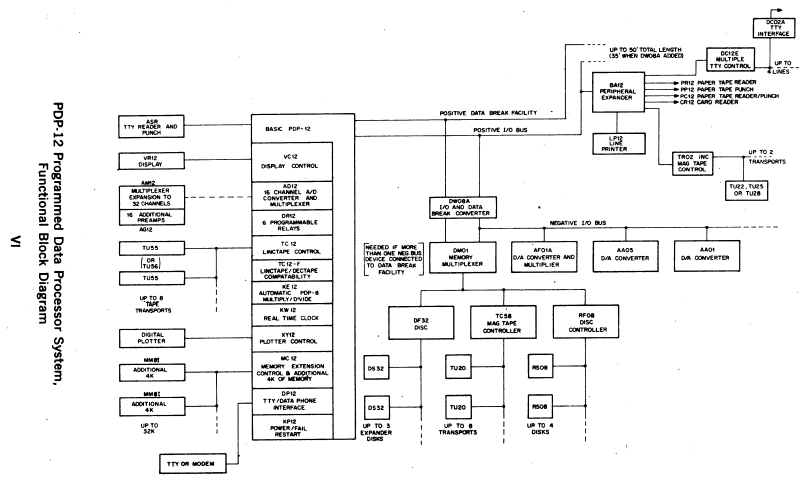
"Flexibility" - The PDP-12 includes within its single central processor tho distinct operating modes, each with its own complete instruction set. Like its predecessor, the LINC-8, the PDP-12 operates in one mode as a LINC (Laboratory INstrument Computer) and in the other mode as a PDP-8 computer - specifically a PDP-8/I. Both operating modes have equal status, and the computer may be stopped and started in either mode, and the programs may switch from one mode to the other at will. Computations in one mode are immediately available to programs operating in the other mode, plus only one set of processor registers are involved.
The basic memory capacity of the PDP-12 is 4096 (4K) 12 bit words and can be expanded to 32,768 (32K) words of 1.6 µsecond core storage.
The input/output facilities are available to the two operating modes of the PDP-12 in the following manner through LINC mode programming:
LINCtape - two tape transports controlled by a buffered subprocessor.
CRT Display - 6" x 9" screen, two intensification channels.
Analog Inputs - eight variable potentiometers, eight external inputs, expandable to 24.
Relay Buffer - six relays for control of external equipment.
In addition to these, the PDP-12 is also equipped with a positive logic PDP-8/I type input/output (I/O) bus, to which can be attached, all PDP-8 peripherals and options such as a high-speed paper tape reader and punch, as well as the standard ASR-33 Teletype.